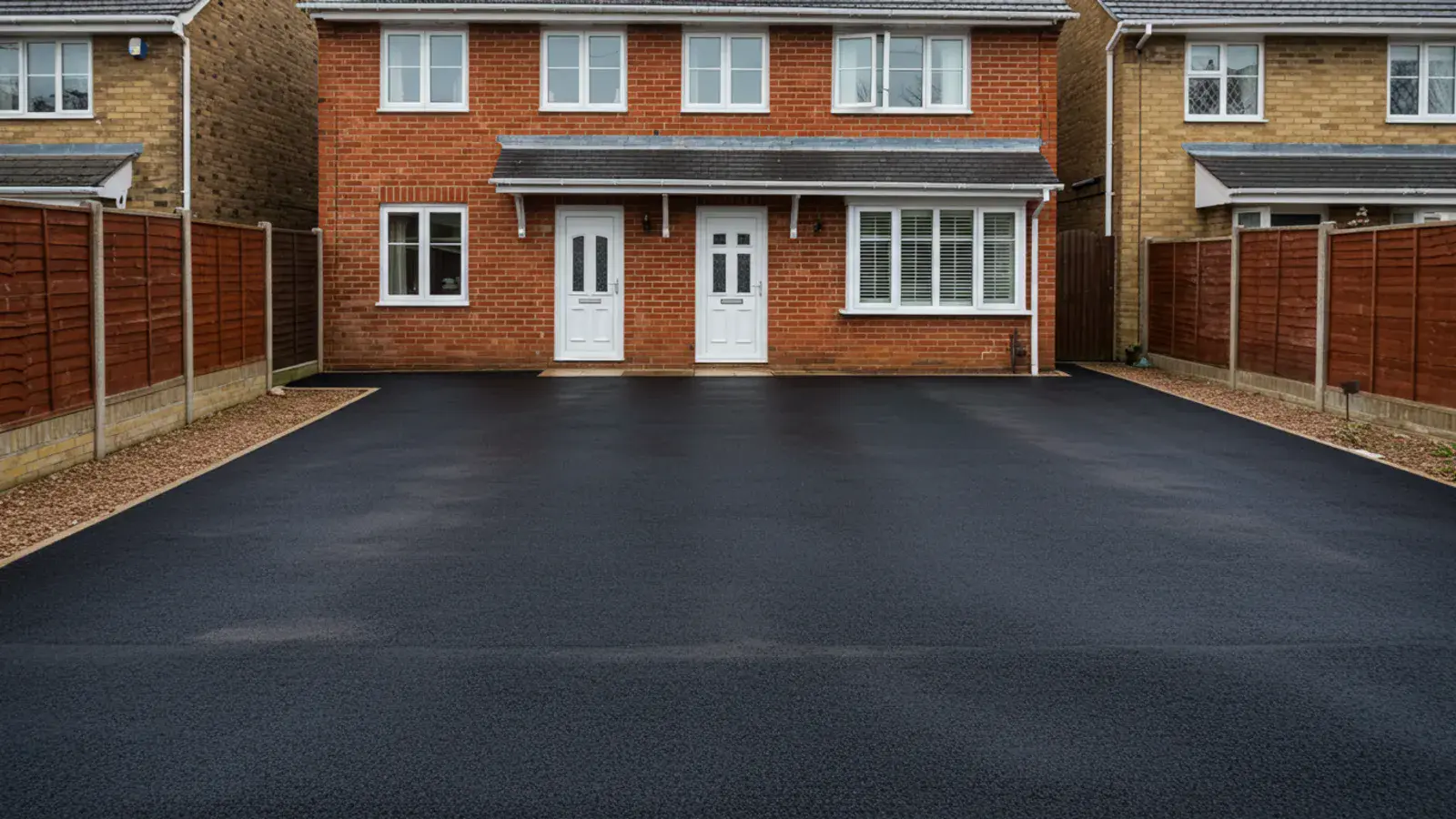
Tarmac restoration in Dewsbury
Cleaning, recolouring and sealing for tarmac drives, forecourts and yards across Dewsbury, Thornhill, Earlsheaton and Ravensthorpe.
Get a free Dewsbury quoteDewsbury is a mill town in the heart of what used to be called the Heavy Woollen District, and its streets are built up the sides of the Calder valley. It is a place of terraces and hillsides, and that is why tarmac here is not quite the same thing it is in the suburbs. The surface you are likely to be looking at is not a long family drive. It is a small forecourt, a side entry, a shared back lane or the yard behind a business.
We clean, recolour and seal tarmac surfaces across Dewsbury and the WF12 and WF13 postcodes, and we treat the small ones with the same attention as the large. A short tarmac strip at the front of a terrace gets the same assessment as a drive.
Small surfaces, steep ground
Dewsbury's terraced streets climb the valley sides steeply, and a lot of the front gardens have been given over to hard standing for a car. Those forecourts are short, they often sit at an angle, and they are usually enclosed by a wall on at least one side. Rain runs along them and out through the gate, taking grit and fine bitumen with it.
A short surface has a long edge in proportion to its area, and the edge is where tarmac fails first. On a forecourt with a wall and a pavement on either side, that means most of the surface is within a few inches of one. We look at those edges and at the line where the tarmac meets the pavement, because a coating over a broken edge simply fails along the break.
Shared lanes and back entries
Many terraces in the older parts of town have a back lane or a shared passage behind them, and those are often tarmac. They carry bins, wheelie-bin storage, a van or two and the rubble of every neighbour's building work, and they get little care because they belong to everybody and nobody. The surface is usually the most worn thing in the street.
If you share a surface, it is worth agreeing before anyone starts. A treatment applied to your length only will show where it stops. We can look at what is practical for a single frontage and what makes sense to do together, and we will tell you if it is better left. Our piece on what restoration costs explains how the size and condition of a surface change the work.
Mill yards, units and car parks
A mill town has more than houses. Many of the old mills along the Calder have been converted to workshops, units and flats, and each has a yard, a loading area or a car park behind it. Those are bigger, busier and dirtier than any front drive. Delivery vehicles turn on them, oil collects under parked vans and the surface has often been patched many times.
Commercial surfaces are cleaned, recoloured and sealed on the same principles as a domestic drive, with a bigger emphasis on the oil. Any oil has to be taken out first, and any patch repairs have to have settled before a coating is applied over them. Tarmac cleaning is where that work starts.
From the valley floor to the hilltops
The ground in Dewsbury rises sharply on both sides of the river. The town centre is in the bottom of the valley. Earlsheaton, Thornhill and Hanging Heaton sit on the high ground above it, and Savile Town and Ravensthorpe lie on the rising ground around the centre. In most of these places the housing is a mixture of terraces from the textile years and interwar and postwar semis built as the town grew.
The valley bottom is damper and holds the cold air on still nights, so surfaces there stay wet and take moss. The ridges are higher and more exposed, and take more wind and frost. Both are hard on tarmac, in different ways, and it is why we look at where a drive actually sits before we say what it needs.
Working across Dewsbury
We cover WF12 and WF13, including Thornhill, Earlsheaton, Ravensthorpe, Hanging Heaton, Savile Town and Dewsbury Moor. The map on the contact page shows the area we serve. Batley is the next town along the valley, Ossett is a short way to the south-east, and Wakefield, where we are based, lies beyond that.
Common questions
- Do you work on small forecourts and back lanes?
- Yes. A short frontage gets the same assessment as a long drive, and we will tell you honestly whether a surface is worth treating. If a lane is shared, it is worth agreeing with neighbours first, because a treatment that stops at a boundary will show where it ends.
- Which parts of Dewsbury do you cover?
- The WF12 and WF13 postcodes, including Thornhill, Earlsheaton, Ravensthorpe, Hanging Heaton, Savile Town and Dewsbury Moor. The map on our contact page shows the area we serve.
- Does a steep surface make a difference?
- It changes where the wear shows. Water takes the same line down the slope each time, so you get pale tracks and a worn patch at the bottom. We look at the fall during the assessment and at any drainage that needs sorting before the surface is treated.
What we offer in Dewsbury
Tarmac Cleaning & Restoration
Specialist cleaning lifts dirt, moss and oxidisation from tired tarmac, restoring a cleaner, safer surface.
Dewsbury tarmac cleaning & restorationTarmac Recolouring
Restore faded, grey tarmac to a rich, deep black with a durable recolouring treatment.
Dewsbury tarmac recolouringMMA Tarmac Coatings
Hard-wearing decorative MMA coatings add colour, grip and protection to tarmac surfaces.
Dewsbury mma tarmac coatingsTarmac Restoration & Sealing
Full restoration and sealing to protect tarmac, enhance colour and extend its lifespan.
Dewsbury tarmac restoration & sealingNearby areas we cover
Restore your Dewsbury tarmac drive
Book a free, no-obligation assessment and we will tell you honestly what your surface needs.
Request your free quote