How to clean tarmac without wrecking it
5 min read Tarmac Revive
More tarmac is damaged by cleaning than by weather. The surface is soft, the binder is soluble, and the equipment most people reach for is the wrong tool.
Of the tarmac drives we are asked to repair, a fair number were damaged by someone trying to improve them. Tarmac is more vulnerable to cleaning than any other hard surface we work on, and it is worth knowing why before pointing a lance at it.
Why tarmac is different
Block paving and concrete are hard mineral surfaces — the risk from pressure is to joint sand or a colour layer. Tarmac is stone held in a bitumen binder that is comparatively soft, thermoplastic, and soluble in petrochemicals. High-pressure water will lift the binder and take the stone with it. There is no equivalent failure mode on a concrete slab.
The four common mistakes
Too much pressure
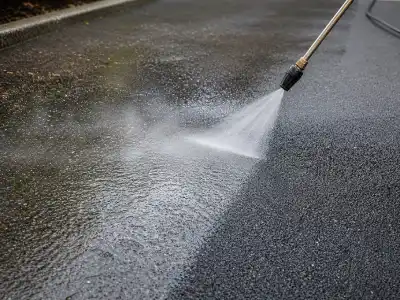
A domestic washer at full power through a narrow nozzle will strip binder and leave a rough, pitted patch, sometimes in a single pass. Once the stone is exposed, that area weathers faster than everything around it.
A turbo or pencil nozzle
These concentrate the whole output into a spinning point. They are made for hard surfaces and they will carve a visible line into tarmac before you have registered what is happening.
Holding the lance too close
Distance matters as much as the pressure setting. Even a moderate fan at two inches will do damage that the same fan at twelve inches will not.
Solvents and fuel
Petrol, diesel and solvent-based cleaners dissolve bitumen. Using them to shift an oil stain makes a small dark mark into a soft, sunken patch. Spilled fuel should be soaked up, not washed in.
Cleaning it safely
- Use a wide fan, never a turbo nozzle. A 40-degree fan or a flat surface cleaner spreads the load.
- Keep well back and keep moving. Steady, overlapping passes; never hold in one spot.
- Start gently. Begin at low pressure in an out-of-the-way area and increase only if you must.
- Treat growth chemically rather than mechanically. A biocide kills moss and algae so it can be brushed off, without needing pressure to blast it away. This is the single most useful change most people can make.
- Use the right detergent. Alkaline degreasers formulated for asphalt, not solvents.
Stains worth knowing about
Oil and fuel — absorb immediately with granules or cat litter, then use an asphalt-safe degreaser. Do not scrub with solvent. Deep contamination sometimes has to be cut out.
Moss and algae — biocide, wait, brush off. Pressure is the wrong tool and it will not stop it returning anyway.
Tyre scuffing — usually cosmetic marking of the surface layer rather than contamination. A restorative seal is what evens it out.
Leaf staining — tannin marks respond to a proper clean, and a sealed surface resists them far better next autumn.
The honest summary
On tarmac, cleaning is preparation rather than the finished job. It removes what is sitting on the surface, but it will not put back the black — that is a binder problem, and it needs a restorative treatment. Anyone promising to jet wash a grey drive back to black is either going to disappoint you or damage it.
Cleaned gently, treated for growth, then sealed: that is the sequence that works, and in that order.
Common questions
- Can I jet wash my tarmac drive?
- With care. Use a wide fan or flat surface cleaner, keep your distance, and never use a turbo nozzle. High pressure at close range strips the bitumen binder.
- Will cleaning make my grey tarmac black again?
- No. Cleaning removes surface dirt and growth. The grey is oxidised binder, and only a restorative bitumen-based treatment restores the colour.
- How do I remove an oil stain from tarmac?
- Absorb the spill with granules or cat litter, then use a degreaser formulated for asphalt. Never use petrol, diesel or solvent cleaners — they dissolve the binder.