How long should a tarmac driveway last?
5 min read Tarmac Revive
A properly built tarmac drive should be good for decades. Most that fail early do so for reasons that had nothing to do with the tarmac itself.
Asked plainly: a well-built domestic tarmac driveway, looked after, should give you twenty years or more. Plenty do considerably better. The ones that fail at eight or ten almost never failed because tarmac is a poor material — they failed for one of a small number of identifiable reasons.
What actually decides it
The base, more than anything
Tarmac is a flexible surface that spreads load into what is beneath it. If the sub-base is too thin, poorly compacted, or laid on soft ground, the surface will rut and crack no matter how good the tarmac on top is. Most early failures are base failures wearing a tarmac costume.
Edge restraint
Tarmac needs holding in from the sides. Without a haunched kerb or edging, wheels running slightly wide break the unsupported edge away, water gets into the exposed base, and the failure works inwards. This is the single most common defect we see and it is entirely preventable at installation.
Drainage
Standing water is the most destructive thing there is for a bitumen surface. It gets in, freezes, expands, and breaks the material apart. A drive with proper falls and a clear gully lasts far longer than an identical one where water pools.
What it carries
A drive built for a family car and then used by a van or a caravan is being asked to do something it was not specified for. Turning wheels while stationary also scuffs the surface layer.
The four things that shorten it most
- Never sealing it. The binder oxidises, embrittles, cracks, and lets water into the base. This is a slow, entirely avoidable failure.
- Ignoring the edges. A small break becomes a large one every winter it is left.
- Blocked drainage. A silted gully quietly does more damage than years of traffic.
- Fuel and solvent spills. Petrol and diesel dissolve bitumen. A spill left to soak in creates a soft patch that never recovers.
What a well-kept drive looks like at twenty years
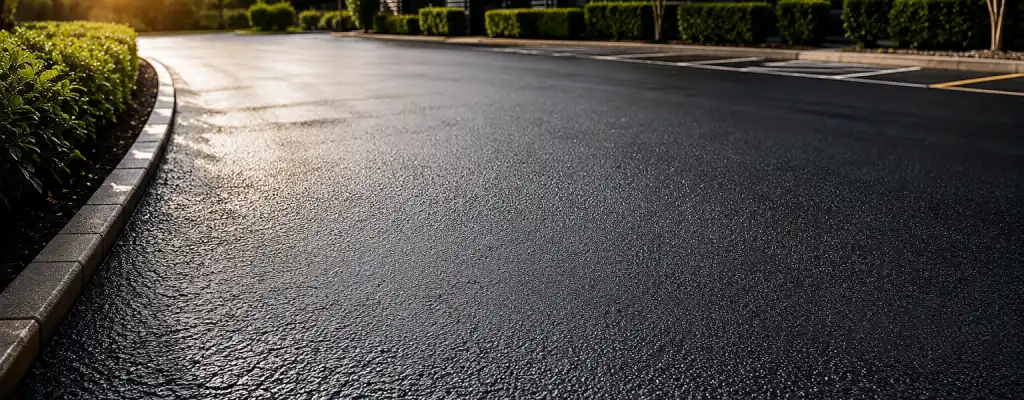
Not new, but sound. Some colour loss between seals, a few fine cracks that have been sealed rather than left, edges intact because they were restrained properly, and no soft spots. That drive needs a clean and a restorative seal every few years and nothing more.
What it will not look like is black. That is fine — the black comes back with the seal.
When it genuinely is at the end
Interlinked cracking across large areas, multiple soft or springy patches, ruts that hold water, and edges gone all round. At that point the base has failed and you are resurfacing or rebuilding, not maintaining.
The useful thing to know is that most drives we are asked to look at are nowhere near that. They look tired and the owner assumes the worst, and what they actually need is a clean and a seal. Worth getting an honest opinion before assuming you need a new driveway.
Common questions
- How long does a tarmac driveway last?
- A well-built domestic drive that is looked after should give twenty years or more. Early failures are usually base or edge problems rather than the tarmac itself.
- What is the most common reason tarmac fails early?
- Lack of proper edge restraint, followed closely by poor drainage. Both let water into the base, which is what actually destroys the surface.
- Does sealing extend the life of tarmac?
- Yes. It keeps water out of the surface and replenishes binder, which is what prevents the crack-then-pothole sequence that ends a drive early.