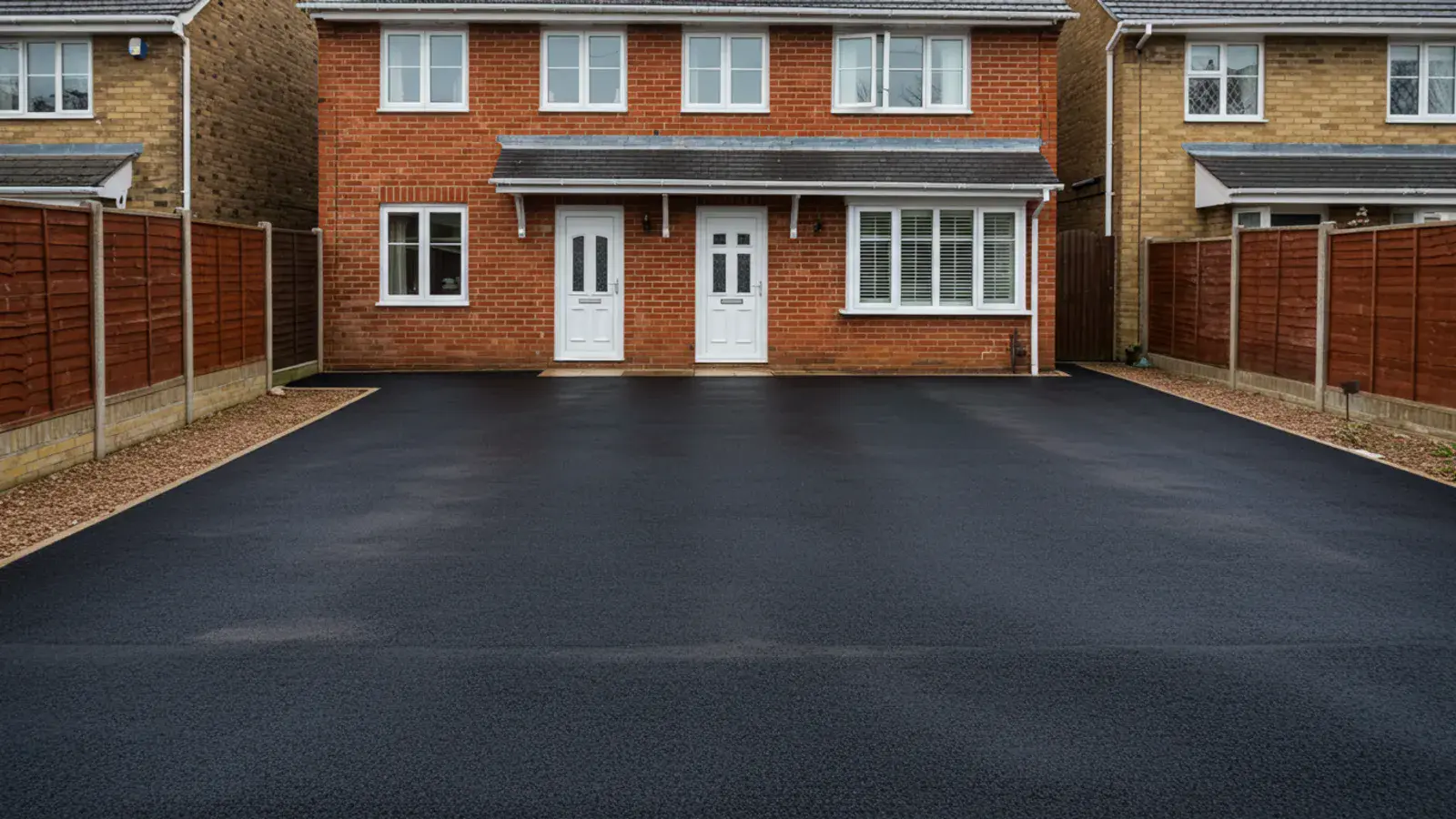
Tarmac restoration in Bradford
Cleaning, recolouring and sealing for tarmac drives across Bradford, Heaton, Manningham, Eccleshill, Idle, Wibsey and Thornton.
Get a free Bradford quoteBradford sits in a bowl. The city centre is at the bottom, the streets climb away from it in every direction, and the suburbs hang on the slopes around the rim. It was built on wool, and the merchants who made their money from it built their houses on the hills above the smoke. All of that has left a place where the gradient is the first thing to know about any driveway.
We clean, recolour and seal tarmac driveways across Bradford and the BD postcodes within our area, and on a city this steep the slope is part of every assessment.
Merchants' villas and their long approaches
Heaton and Manningham are known for the large Victorian houses that were built for the people who ran the wool trade. Many have long, curving approaches, stone gate piers, mature gardens and a fall of several metres from gate to door. The tarmac on them is often decades old, laid over earlier surfaces, and on a long drive on a slope it has had a hard life.
The shade is the other thing: tall trees and high walls keep the sun off, and water flows down the drive for months of the year. A drive like that needs the structure checked and the edges looked at before the colour is considered. Why tarmac fades to grey explains the weathering, and the first question is whether the surface underneath is still sound.
Gradient, run-off and the bottom of the slope
On a steep drive, every shower is a small river. The water follows the same line, usually the wheel tracks, and carries grit and fine binder with it. It collects at the bottom, against the gate or the garage door or the pavement, and that is where the surface breaks down first. The top of a steep drive can look fine while the bottom is breaking up.
Tarmac on a slope also takes more stress in warm weather, because heavy, braking or turning vehicles push the surface downhill, and on a hot day the surface is softer. Treating the surface does not change the gradient. What it does is restore the colour and close the surface, which slows the loss of binder. We tell you what is realistic for a steep drive, and what is a drainage question rather than a surface one.
Retaining walls, steps and terraces
A city built on hills has a great many retaining walls, and a great many drives cut into a bank. A wall holds soil and water behind it and pushes against the edge of the tarmac, and the strip alongside it is often the first to crack. Water weeping through the wall keeps the strip damp and grows moss.
Stone terraces are a different matter again. Close to the centre and in the older districts, most houses open straight on to the pavement, and the off-street space, where there is one, is a small paved or tarmac pad at the side or the back. Small surfaces are assessed the same way as large ones, and the edges are what we look at hardest. Tarmac restoration is the route for surfaces with wear that has gone beyond colour.
Estates, ring roads and the outer suburbs
Beyond the old hillsides, the city has large areas of interwar and postwar housing, with semis, bungalows and former council estates, and more recent development towards the outer edges at places like Wibsey, Thornton and Eccleshill. The drives are shorter and the surfaces simpler, and the exposure is more varied, with some high and open and some sheltered.
On these the issue is most often the one every tarmac drive faces: the binder has weathered and the colour has gone. Recolouring puts it back, and what recolouring actually does sets out what it does and does not change. We would always rather tell you a drive is sound and only needs colour than sell you a repair it does not need.
Working across Bradford
We work across the city and its suburbs, including Heaton, Manningham, Eccleshill, Idle, Wibsey and Thornton. The BD postcodes cover a large district, and we do not cover all of it: the map on our contact page shows the area we serve, so check it if you are on the edges. Batley and Halifax are the nearest of our other pages, and Leeds is just to the east.
Common questions
- Do you cover the whole of Bradford?
- We cover the city and its suburbs within our area, including Heaton, Manningham, Eccleshill, Idle, Wibsey and Thornton. The BD postcodes cover a much larger district than that, so check the map on our contact page, and ask if you are on the edge of it.
- My drive is steep. Does that cause a problem?
- It affects where the wear shows. Water runs down the wheel tracks and collects at the bottom, so the surface there breaks down first. Treating the surface restores colour and closes it, but it does not change the gradient, and we will tell you if the water is the real issue.
- I only have a small paved pad at the side of my terrace. Is it worth treating?
- It depends on the condition, and we will tell you honestly. A small surface is assessed the same way as a large drive, and the edges are the part we look at hardest.
What we offer in Bradford
Tarmac Cleaning & Restoration
Specialist cleaning lifts dirt, moss and oxidisation from tired tarmac, restoring a cleaner, safer surface.
Bradford tarmac cleaning & restorationTarmac Recolouring
Restore faded, grey tarmac to a rich, deep black with a durable recolouring treatment.
Bradford tarmac recolouringMMA Tarmac Coatings
Hard-wearing decorative MMA coatings add colour, grip and protection to tarmac surfaces.
Bradford mma tarmac coatingsTarmac Restoration & Sealing
Full restoration and sealing to protect tarmac, enhance colour and extend its lifespan.
Bradford tarmac restoration & sealingNearby areas we cover
Restore your Bradford tarmac drive
Book a free, no-obligation assessment and we will tell you honestly what your surface needs.
Request your free quote