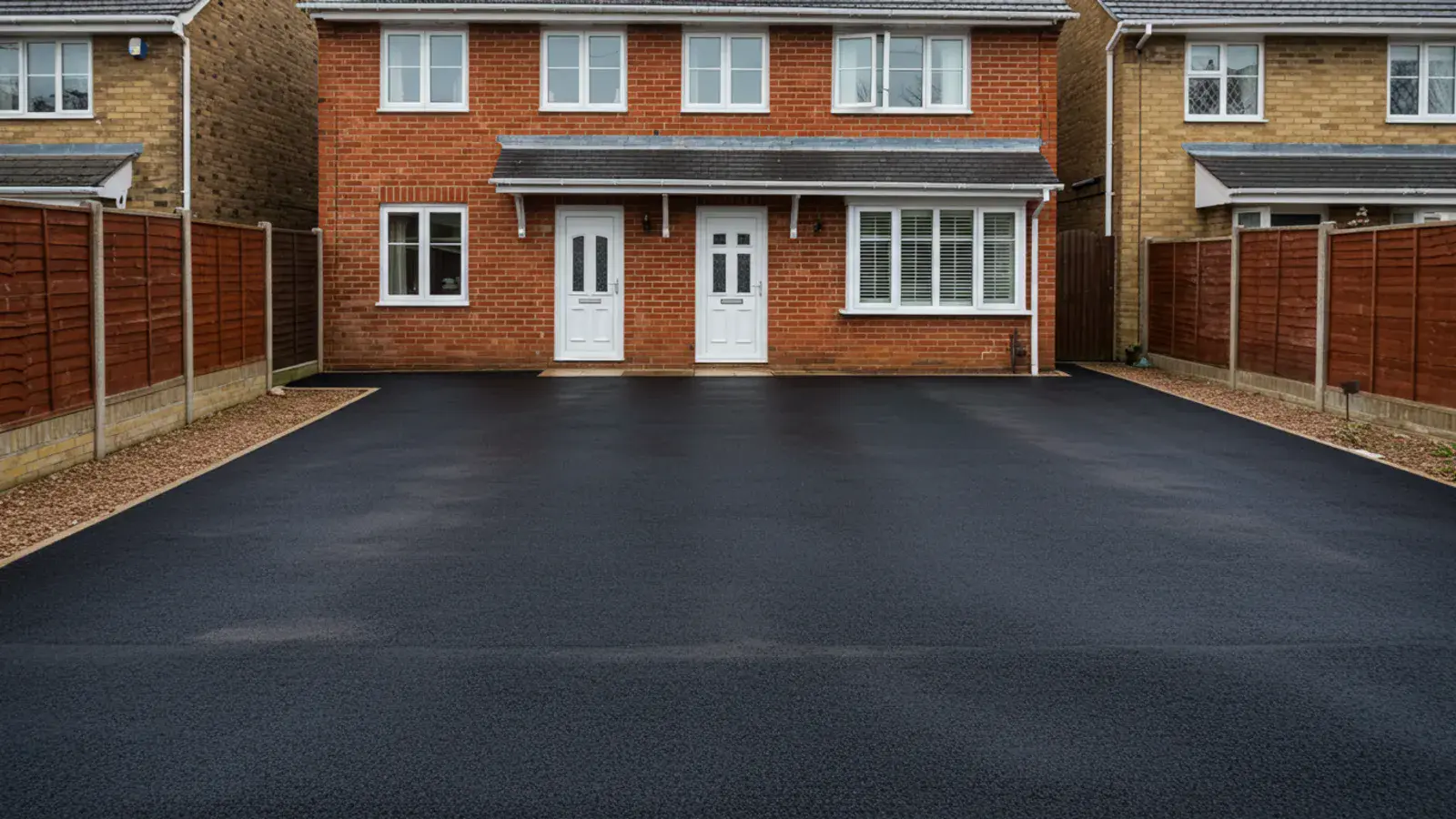
Tarmac restoration in Castleford
Cleaning, recolouring and sealing for tarmac drives across Castleford, Glasshoughton, Whitwood, Airedale and Fryston.
Get a free Castleford quoteCastleford sits where the River Aire and the River Calder meet, and it is some of the flattest ground in this part of West Yorkshire. That has a simple consequence for a tarmac drive: water has very little reason to leave it. Where a hillside drive sheds the rain in seconds, a drive in the valley floor can hold on to it for the rest of the day.
We clean, recolour and seal tarmac driveways and private access roads throughout Castleford and the WF10 postcodes. Most of what we find here is a drainage and damp problem first and a colour problem second, and it is worth being clear about that before anything is coated.
Flat ground, slow water
A drive needs a fall, a gentle slope that carries the water to a gully, a lawn or the road. On the hills nature supplies it. In a river flood plain the fall has to be built in, and over the years it is often lost: a slight dip develops where a car always parks, tarmac settles over a soft patch, or the gully at the bottom silts up. The result is a puddle that stays for a day or two after every shower.
The trade calls those birdbaths, and they are more than an eyesore. The surface under a birdbath is wet far longer than the rest, so the bitumen weathers faster, algae gets a foothold and a freeze lifts the surface a little more each winter. A coating will cover a birdbath, but it will not stop one forming again, and we would rather you knew where the water goes before anything is put on. Our guide to sealing a tarmac driveway covers when sealing helps and when it only hides the problem.
A town that has been under water
Castleford has been flooded by the Aire in living memory, and anyone who has lived through it knows how long a house and a garden take to dry. Drives take their time as well. Ground that has been saturated can move, tarmac laid over it can sink or crack, and the base can be left softer than it was.
If your drive has been through flood water, or you suspect the ground underneath it has moved, we look for that at the assessment: soft patches, settlement along the edge, cracks that run in lines instead of a web. Cosmetic work over a surface that is still moving only buys a few months, and we will tell you if repair is the better first step.
Glass, coal and the houses they built
The town has made glass and pottery, and it has mined coal, and the housing is a record of that. There are terraces close to the river from the earlier industrial period, large areas of postwar council and private housing, and newer estates built on land that used to belong to the pits. Glasshoughton, to the east, is a good example of the last: a lot of it is relatively recent building on what was industrial ground.
For tarmac, the age of the estate is a reliable guide. A drive on a 1950s estate is likely to be on its second or third surface. A drive on a 1990s or later close may still be on its original wearing course and in the middle of its fade. We deal with both, but the questions differ, because the older ones need to be checked for structure first and the younger ones mostly need the surface bringing back.
Motorways, dust and diesel
Castleford is ringed by major roads, with the M62 and the A1(M) close by and a good deal of heavy traffic through and around the town. Roadside drives and those near the busier routes collect a film of traffic dirt that settles on the damp surface and darkens it in the wrong way, a grimy grey instead of a clean black.
Oil is the other thing that turns up. Cars that are parked on the same spot for years leave drips, and oil dissolves bitumen, so the spot goes soft and pale. It has to be cleaned out before anything else, because a coating laid over oil will lift off it in sheets. Cleaning tarmac without damaging it explains how that is done without stripping the good surface around it.
Working across Castleford
We cover the WF10 postcodes, including Glasshoughton, Whitwood, Airedale, Fryston and Smawthorne. If you are unsure whether you are inside the area, the map on the contact page shows the area we serve. The neighbouring town of Pontefract is to the east, Leeds to the north-west, and Wakefield, where we are based, to the south-west.
Common questions
- Why does my flat drive hold puddles for so long?
- A drive needs a fall to carry water away, and on flat ground that fall can be lost over the years, through settlement, a silted gully or the surface wearing into a dip. We check where the water goes at the assessment, because a coating over a birdbath does not stop it forming again.
- Do you cover Glasshoughton and Whitwood?
- Yes. We cover the WF10 postcodes, which includes Glasshoughton, Whitwood, Airedale, Fryston and Smawthorne. The map on our contact page shows the area we serve.
- Can a drive that has been under flood water be restored?
- Often, but it has to be checked first. Saturated ground can move, and tarmac over it can sink or crack. We look for soft patches and cracks that run in lines at the assessment, and the surface has to be fully dry before anything is put on it.
What we offer in Castleford
Tarmac Cleaning & Restoration
Specialist cleaning lifts dirt, moss and oxidisation from tired tarmac, restoring a cleaner, safer surface.
Castleford tarmac cleaning & restorationTarmac Recolouring
Restore faded, grey tarmac to a rich, deep black with a durable recolouring treatment.
Castleford tarmac recolouringMMA Tarmac Coatings
Hard-wearing decorative MMA coatings add colour, grip and protection to tarmac surfaces.
Castleford mma tarmac coatingsTarmac Restoration & Sealing
Full restoration and sealing to protect tarmac, enhance colour and extend its lifespan.
Castleford tarmac restoration & sealingNearby areas we cover
Restore your Castleford tarmac drive
Book a free, no-obligation assessment and we will tell you honestly what your surface needs.
Request your free quote