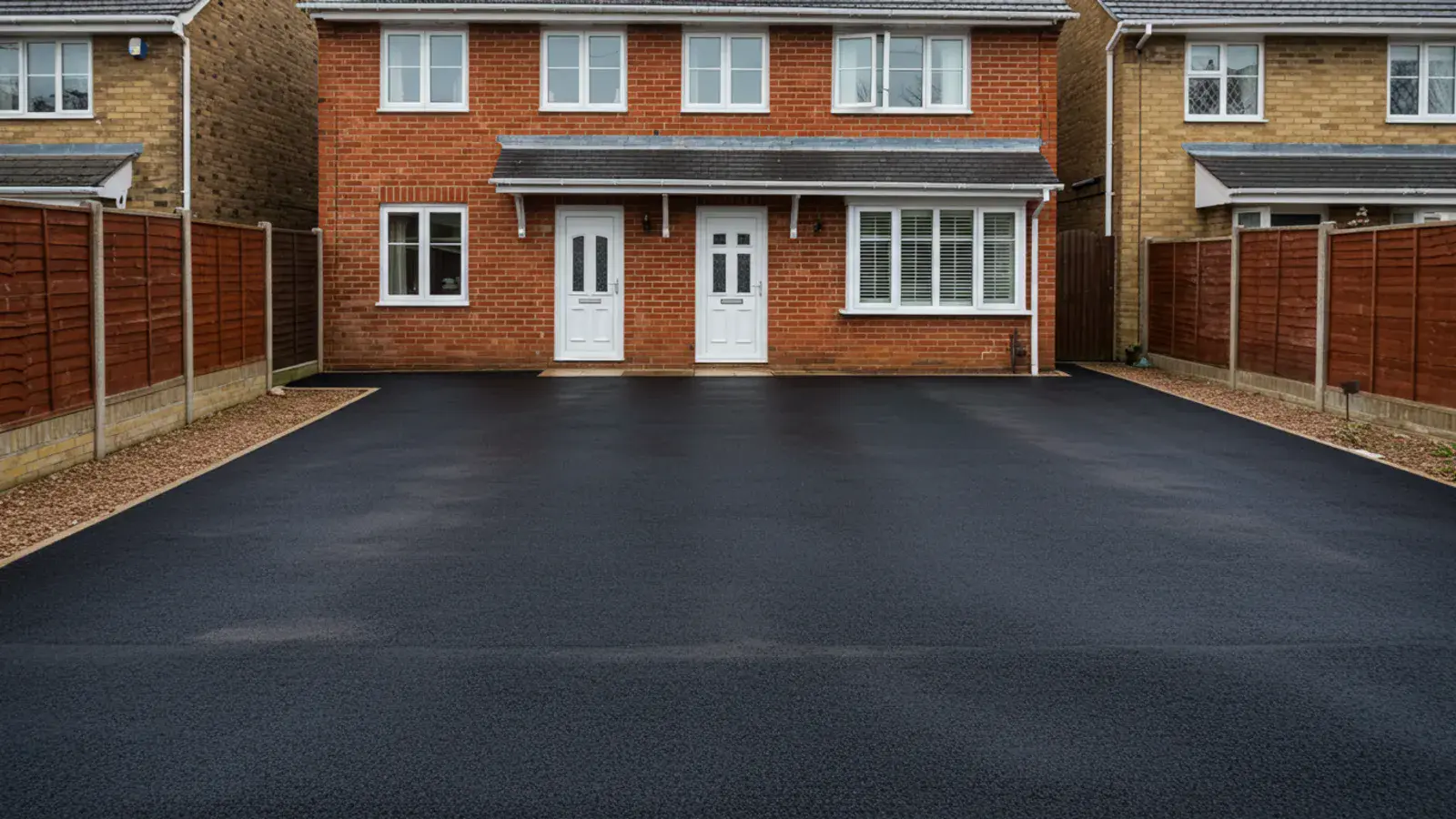
Tarmac restoration in Pontefract
Cleaning, recolouring and sealing for tarmac drives in Pontefract, Carleton, Monkhill, Ackworth and the villages around.
Get a free Pontefract quotePontefract is an old town, and its driveways show it. The centre is a market town with a medieval castle on the rock above it, Georgian and Victorian streets running out from the market place, and a ring of interwar and postwar estates beyond. A tarmac drive in the older streets is rarely the first surface to have been put down in that spot, and that history is what decides what it needs now.
We clean, recolour and seal tarmac driveways and private access roads in Pontefract and the villages around it. Every surface is looked at on its own merits, and what we recommend depends on what is actually underneath the grey.
A drive that has been resurfaced before
On a street that has been built up for a few hundred years, tarmac tends to be a layer on top of an earlier layer. Drives get overlaid when they wear out, and each overlay adds to the depth. After two or three of them the surface can sit proud of where it started, with the edge now level with the damp-proof course, the water running towards the house instead of away from it, and the gully at the bottom sitting a little higher than the tarmac around it.
None of that is fixed by a coat of black, and it is worth knowing before anyone puts one on. If water now collects against a wall or a door, the first job is to look at the fall of the drive and where the water is going. Recolouring restores the colour and closes the surface; it does not change a level. Our note on crumbling edges and potholes covers the damage that comes from old surfaces failing at the edges.
Old surface, old binder
The older the tarmac, the less bitumen is left in the top of it. The binder is what makes a new drive black, and sunlight and rain take it away slowly, so the stone underneath shows through as grey. An old drive in Pontefract that has been through forty or fifty winters can look finished while still being sound, and the reverse is also true: a drive that looks acceptable from the window can be crumbling at the edges.
That is why we look at the edges, the joins where one resurfacing met another, and any cracks you can get a fingertip into before we talk about colour. Why tarmac fades to grey sets out what is happening to the surface, and what recolouring actually does explains what putting binder back can and cannot change.
Mature trees, old walls and little sun
The older parts of the town have mature trees and tall boundary walls, and both keep sunlight off the ground. A drive that gets sun for a few hours a day dries out; one in the shadow of a stone wall and a sycamore may not. Leaves, seeds and honeydew sit on it and break down into a green film, and the film is slippery long before it looks serious. A clean takes it off, and the choice of how to clean is covered in cleaning tarmac without damaging it.
Roots are the other thing to watch for. A tree that has stood beside a drive for decades will have roots under it, and where they lift the surface the fix is a repair, not a coating. If your property is listed or sits in a conservation area and you are thinking of changing the look or the layout of a frontage, check with the council before you commission anything. Restoring an existing tarmac drive keeps the same material in the same place.
Beyond the centre: the estates and the villages
Away from the old core, Carleton and Monkhill are largely twentieth-century housing, with semis and bungalows on drives that were laid when the estates went up. The colliery and its rows are part of the story of the town, and a lot of the housing around it was built for the people who worked there. Tarmac laid in one go along a street tends to age in one go as well, so neighbours often find that their drives have faded at roughly the same rate.
Out at Ackworth and Darrington the setting is more village than town, with longer drives, more garden and generally more exposure. A drive that crosses a field edge or runs alongside a hedge picks up different problems from a town frontage, mostly from vegetation and from water that has nowhere to go.
Working across Pontefract and the villages
We work throughout the WF7 and WF8 postcodes, including Carleton, Monkhill, Tanshelf, Ackworth and Darrington. The map on our contact page shows the area we serve, and if you are on the edge of it, ask. Pontefract sits close to Castleford to the north-west, and Wakefield, where we are based, lies to the west.
Common questions
- Do you cover Ackworth and Darrington as well as Pontefract?
- Yes. We cover the WF7 and WF8 postcodes, which takes in Carleton, Monkhill, Tanshelf, Ackworth and Darrington. The map on our contact page shows the area we serve, so ask if you are not sure.
- My drive has been resurfaced several times and now sits higher than my door. Will recolouring help?
- It will not change the level. Recolouring restores colour and closes the surface; it does not lower a drive that has been built up. If water is running towards the house, we will look at the fall of the drive and tell you honestly what can and cannot be done.
- Does it matter that my house is in a conservation area?
- Restoring an existing tarmac drive keeps the same material in the same place, so it is a different thing from changing a frontage. If you are planning to change the look or layout of a property that is listed or in a conservation area, check with the council first.
What we offer in Pontefract
Tarmac Cleaning & Restoration
Specialist cleaning lifts dirt, moss and oxidisation from tired tarmac, restoring a cleaner, safer surface.
Pontefract tarmac cleaning & restorationTarmac Recolouring
Restore faded, grey tarmac to a rich, deep black with a durable recolouring treatment.
Pontefract tarmac recolouringMMA Tarmac Coatings
Hard-wearing decorative MMA coatings add colour, grip and protection to tarmac surfaces.
Pontefract mma tarmac coatingsTarmac Restoration & Sealing
Full restoration and sealing to protect tarmac, enhance colour and extend its lifespan.
Pontefract tarmac restoration & sealingNearby areas we cover
Restore your Pontefract tarmac drive
Book a free, no-obligation assessment and we will tell you honestly what your surface needs.
Request your free quote